
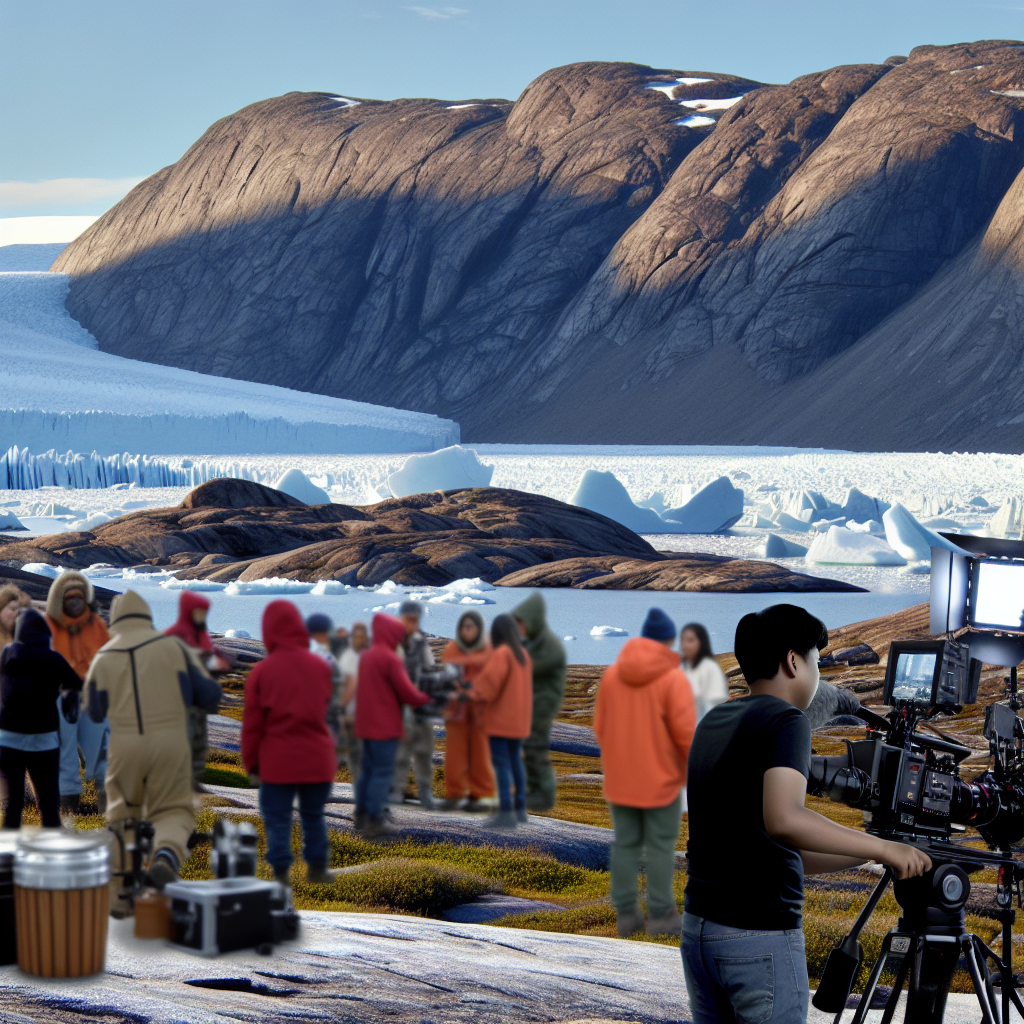
A Year of Reflection and Aspiration for Greenland’s Film Industry
Was it Simon Spies from Denmark who famously claimed that all advertising is good advertising? Klaus Georg Hansen poses this thought-provoking question, connecting from his Teams setup in Copenhagen. As the chairman of Film.gl, he reflects on a remarkable 2025 for the film industry, marked by unprecedented interest both at home and abroad.
In the early months of the year, filmmakers across Greenland were met with a surge of international attention, largely ignited by events surrounding former President Donald Trump’s remarks about the region. “Trump has given us some advertising that we simply cannot buy,” Hansen quips, highlighting a flurry of foreign journalists and documentarians who have pursued stories centered on Greenland since those fateful declarations.
For Hansen, 2025 also represents a watershed moment for Greenlandic cinema. The Film Act took effect on January 1, alongside the establishment of a new film institute, both designed to bolster the infrastructure for local filmmakers. Additionally, two standout documentaries have made waves internationally, signaling Greenland’s emergence on the global film stage.
The Bright Horizon of Film Exports
Earlier this month, Hansen found himself in London, attending FOCUS, Europe’s largest market for film locations. During this two-day event, he saw Greenland alongside other countries, all eager to attract foreign production companies scoping potential filming sites. “This year, I had more appointments than ever,” he notes, his enthusiasm evident. “People are genuinely interested in learning about Greenland.”
The growing interest from industry giants like Netflix and Disney has further fueled Hansen’s ambitions that Greenland could become an export hub for filmmaking. “It’s an avenue where we can generate income for our society,” he asserts, while acknowledging the hard work it will take to navigate a fiercely competitive global environment.
Building a robust film industry in Greenland will require foundational elements such as skilled crews and advanced facilities. However, Hansen is optimistic. “The new film act and the newly formed film institute set us on the right path,” he explains.
Recently appointed, the Greenland Film Institute’s director, Inunnguaq Petrussen, echoes this sentiment. “Let’s develop a film industry that enables local filmmakers to realize their dreams through ample support and resources,” he states passionately.
Spotlight on Groundbreaking Documentaries
When discussing the defining films of 2025, one cannot overlook “Greenland’s White Gold” (Orsugiak). This documentary dives deep into the cryolite mine in Ivittuut, exploring its historical significance and its impact on both Danish companies and the Greenlandic populace. “This film has not only transformed perceptions of the Greenlandic film industry but has also questioned Denmark’s historical narrative,” Hansen observes.
Premiering on Danish television on February 9, the documentary triggered an immediate and intense reaction, both praised and criticized. Nine days post-premiere, it was withdrawn by DR, eliciting public outrage both in Greenland and Denmark. “The filmmakers became heroes here but were scorned in Denmark,” Hansen notes, capturing the emotional fallout from the controversy.
The documentary has stirred not only debate around colonial history but also pride in the capabilities of Greenlandic filmmakers, a sentiment echoed across the industry.
Meanwhile, the film “Walls – Akinni Inuk,” directed by Nina Paninnguaq Skydsbjerg and Sofie Rørdam, has also made a significant impact. It depicts life in a Nuuk correctional facility through the eyes of Ruth Mikaelsen Jerimiassen, who is serving an indefinite sentence. “It’s impressive to see how film can shape perceptions,” Petrussen reflects. This documentary won the Best Nordic Documentary award at CPH:DOX and was nominated for the Nordic Council’s Film Prize and Greenland’s first Oscar bid since 2012, though it ultimately fell short.
The Future of Greenlandic Film
As 2025 draws to a close, both Hansen and Petrussen are hopeful about the film industry’s trajectory. With new policies and initiatives paving the way, the groundwork is now laid for elevated international interest. However, Hansen cautions against complacency. “We can’t expect major film studios to flock to us overnight,” he insists. “We still have much to learn.”
Reflecting on the ongoing interest sparked by Trump’s comments, Hansen is resolute. “Film production is a lengthy process. Just because attention wanes doesn’t mean the industry will forget Greenland. The spotlight has been cast, and the film world has taken notice.”
As they consider the year ahead, both men find themselves hopeful—not just for the industry but for the stories and opportunities that lie waiting to be told in this astonishing land.