
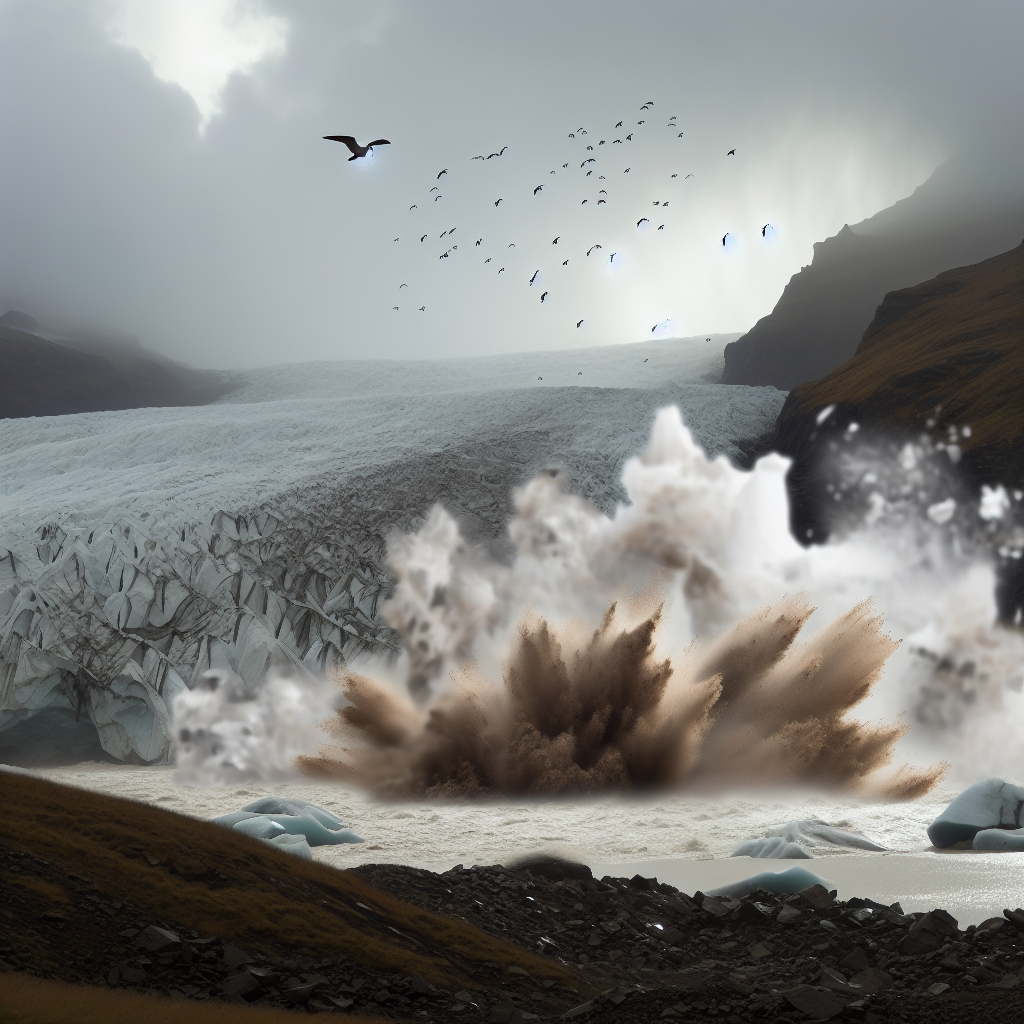
Grímsvötn (Photo: Weather Office of Iceland/Oddur Sigurðsson)
Seismic Tremors Rise Alongside Glacial Flooding at Grímsfjall
- Experts anticipate peak discharge by the end of this week, should the situation evolve as it has in previous glacial outburst floods from Grímsvötn.
- Fortunately, the flood is not projected to impact key infrastructure, including roads and bridges.
- Since November 2021, Grímsvötn has experienced nearly annual glacial outburst floods, with the last significant event recorded in 2018.
- While some volcanic eruptions have followed pressure releases post-flood, most glacial outbursts occur without leading to eruptions.
In recent days, seismographs at Grímsfjall have detected a steady uptick in seismic tremors, signaling the onset of a glacial outburst flood from Grímsvötn. These floods typically emerge from beneath the Skeiðarárjökull glacier, cascading into the Gígjukvísl river. Generally, such floods exhibit a gradual build-up, often taking several days for the first signs of rising water levels to manifest at local hydrological stations, with peak flow materializing shortly thereafter. Given the recent precipitation across southeast Iceland—and more rain expected in the days ahead—the early detection of flood signs in Gígjukvísl could prove elusive.
The tremor graph from the Grímsfjall seismometer illustrates data across three distinct frequency bands. This visual aids scientists in discerning the sources of various tremors, with the blue line (2-4 Hz) indicating a consistent rise in flood-related tremors over the past few days.
The last glacial outburst from Grímsvötn transpired nearly a year ago, with floods occurring roughly annually since November 2021. Before this recent pattern, the intervals between floods were significantly longer, with 2018 marking the last event prior to the uptick in 2021. Current estimates from the Institute of Earth Sciences at the University of Iceland indicate that the water volume in Grímsvötn is around 0.25 km³—comparable to or slightly less than levels before the last flood. Notably, this amount is about one-third of what was recorded before the substantial flood in late 2021.
At present, communication with the GPS equipment operated by the Institute of Earth Sciences at the Grímsvötn ice shelf remains disrupted, complicating efforts to gauge the outflow rate from the subglacial lake and any subsequent developments. Nevertheless, the seismic tremor measurements at Grímsfjall provide valuable insights into the flood’s progression. Should this event follow past trends, experts expect peak discharge from Grímsvötn by the end of the week, with peak flows at Gígjukvísl—located near Road No. 1—likely occurring 1 to 2 days later. According to the current water volume assessments, peak discharge is not projected to exceed 1,000 m³/s, which poses little risk to surrounding infrastructure.
A map detailing the anticipated flood route from Grímsvötn into the Gígjukvísl river via Skeiðarársandur. The hydrological station in Gígjukvísl (V159) is highlighted.
Previously recorded floods have resulted in the formation of new cauldrons on the glacier’s surface, particularly along the flood path southeast of Grímsfjall. As such, those traversing Vatnajökull should exercise extreme caution when in proximity to Grímsfjall. Additionally, there is a risk of gas emissions at the edge of the glacier where floodwaters surface.
While there have been instances of volcanic eruptions following glacial outburst floods, these events are relatively uncommon. The last significant volcanic activity correlated with such a flood occurred in 2004, with previous occurrences in 1934 and 1922. In contrast, since 2004, there have been 13 floods that did not precipitate eruptions. The most recent eruption in Grímsvötn took place in 2011, and it was not associated with any prior floods.
Although seismic activity around Grímsvötn has remained within expected background levels in recent months, increased earthquake activity is anticipated during the flood event. The Icelandic Meteorological Office’s (IMO) round-the-clock monitoring team, in collaboration with experts from the Institute of Earth Sciences, will closely observe the evolving situation over the next few days. Further updates will be provided later this week, along with daily reports from natural hazard specialists on the IMO’s website.
Due to uncertainties surrounding the event’s progression and the potential connection between floods and eruptions at Grímsvötn, the IMO will reassess the aviation color code as peak conditions approach or if circumstances change.
Understanding Grímsvötn and its Glacial Floods
Grímsvötn is among Iceland’s most dynamic volcanic systems, located centrally within the Vatnajökull glacier. Its caldera houses a subglacial lake formed by geothermal activity and surface meltwater. When pressure and volume thresholds are reached, water breaks through the glacier’s base, flowing eastward into Gígjukvísl.
Throughout the past two centuries, approximately 20 eruptions have been documented in Grímsvötn and its vicinity. The last substantial eruption in 2011 registered as an intense event (Volcanic Explosivity Index=4). Other more recent eruptions were shorter-lived, generally spanning a few days. For additional details regarding Grímsvötn, interested readers can explore the Catalog of Icelandic Volcanoes.