
Protective barriers enveloping the Svartsengi area in early November 2024. (Photo: The Icelandic Met Office / Bjarki Kaldalóns Friis)
Ongoing Uplift at Svartsengi: Hazard Assessment Remains Unchanged; Map Valid Until July 31, 2025
Updated at 11:30, July 20, 2025
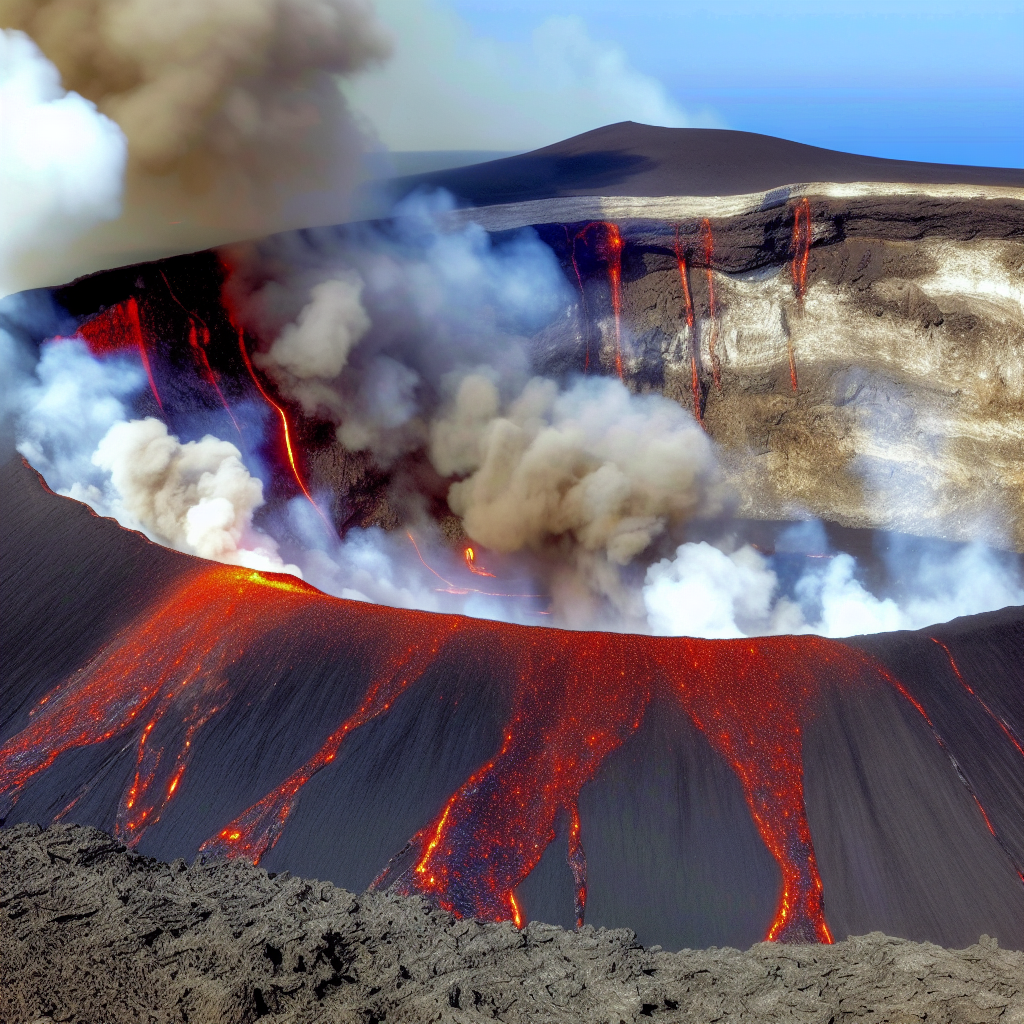
The recent eruption at the Sundhnúkur crater row has led to notable air pollution, with volcanic haze spreading across the region. Unfortunately, this pollution has not been fully captured by the national air quality monitoring network. The Icelandic Meteorological Office (IMO) warns that gas pollution will likely persist in South and West Iceland over the coming days, exacerbated by light winds that will maintain the haze, particularly in the southwest. Vulnerable populations are urged to limit outdoor exposure if they experience any discomfort, and indoor safety guidelines are available for those affected.
As of July 15, 2025, deformation data continues to reveal ongoing uplift at Svartsengi, although the rate has slightly declined in recent weeks. It appears that approximately two-thirds of the magma withdrawn from the chamber during the April 1 event has since been re-accumulated. Should this magma accumulation rate hold steady, experts anticipate an increased probability of either a magma intrusion or an eruption as autumn approaches.
Seismic activity remains a concern, particularly in the Sundhnúkur area and near Fagradalsfjall, with a slight uptick in tremors reported in recent weeks.
Unchanged Hazard Assessment for Svartsengi
The hazard assessment has not changed and will remain valid until July 29, 2025. Any significant developments will be communicated on that date. The current hazard map outlines existing threats in the area and potential risks should volcanic activity continue in the Svartsengi system.
Update – July 1
- Uplift and seismic activity persist in Svartsengi, with stable activity levels reported.
- Magma accumulation continues beneath Svartsengi.
- No substantial changes warranting a revision of the current hazard assessment have been noted.
- It is expected that continued magma accumulation will raise the risk of intrusion or eruption.
- The hazard map remains valid until July 15, 2025, unless conditions dictate otherwise.
Land uplift and seismic activity continue in Svartsengi, maintaining stable levels in recent weeks. On average, around ten micro-earthquakes have been detected daily, predominantly located north of Grindavík and south of Stóra Skógfell.
Update – June 18
Ground Deformation (GPS Data)
Recent GPS data indicates ongoing uplift in Svartsengi, although the rate has diminished in recent weeks. Scientists at the IMO believe that if magma accumulation continues, the risk of intrusion or eruption will rise in the autumn. Historical data suggests an equivalent volume of magma to that of previous events is needed for another significant occurrence.
Image 1: Magma Accumulation Under Svartsengi (October 2023 – June 2025)
This image illustrates the estimated magma volume in the crust at Svartsengi over time, with each hue representing intervals between magma intrusions or eruptions. Although magma accumulation remains relatively steady week to week, the inflow rate has gradually decreased over extended periods.
Image 2: GPS Measurements from Svartsengi (SENG)
This data reflects movements in the north (top image), east (middle image), and vertical (bottom image) directions from November 2023 through June 17, 2025. Uplift continues but has slowed in recent weeks. Red lines mark significant events like magma intrusions and eruptions, indicating a recent decrease in uplift rates.
Image 3: GPS Measurements from Fagridalur (FAGD)
This chart shows deformation at the GPS station FAGD, situated west of Fagradalsfjall, illustrating northward (top), eastward (middle), and vertical movements (bottom). Established in summer 2024, this data doesn’t extend beyond that point. Blue lines denote intrusions without eruptions, while red lines indicate volcanic eruptions. Notably, the intrusion on April 1 occurred just west of this station, causing a clearly observable land shift southeast, aligning with the magma intrusion path.
The eruption on April 1, 2025, while smaller in terms of lava flow compared to previous activities, was still extensive, primarily from a magma intrusion that traveled northward, even extending beyond Keilir. This event mirrors the November 10, 2023 incident, although that eruption primarily progressed southward beneath Grindavík. Thus, the April 1 eruption stands as the second largest in the Sundhnúkur series, surpassed only by its November predecessor.
Deformation Patterns During Magma Intrusions
Deformation tracked during magma intrusions typically forms a graben above the intrusion site, causing the crust on either side of the dike to move outward and lift. Concurrently, subsidence is recorded in Svartsengi as magma exits the chamber and fills the dike.
Monitoring near Svartsengi illustrates both phenomena: the SENG GPS station shows some subsidence, though less than what the magma outflow triggers due to dike formation effects. When modeling magma accumulation at Svartsengi, it’s essential to account for the deformation linked to dike formation. Currently, uplift around Svartsengi has returned to levels seen before April 1, but just over half of the magma volume that exited the chamber has been replaced.
Earthquake Activity
Seismic activity has remained fairly consistent over the past weeks, averaging about ten micro-earthquakes each day. The majority of these tremors are located just north of Grindavík.
Hazard Map
The hazard map has been revised and remains valid until July 15, 2025. This version is largely similar to the previous one, though a few minor updates are noteworthy.
Image 4: IMO’s Hazard Map
The area stretching between Vogaheiði and Fagradals-Hagafell is now classified as low hazard, a shift from its previous designation of moderate hazard due to a reevaluation of eruptive fissure risks. This also applies to the southwestern end of Zone A (Grindavík). For additional details on the evaluation process, please visit the following link: Hazard Assessment Explanation.
Furthermore, the potential for sinkholes is now identified as a concern in Zone C (Vogar) due to previously unnoticed fractures tied to the event on April 1, where the magmatic dike extended northeast of Stóra-Skógafell, revealing these minor fractures upon closer examination.
This map aims to communicate both current hazards and those that may emerge as unrest continues within the Svartsengi volcanic system.
Update – June 3
- Uplift at Svartsengi remains consistent.
- As magma accumulation persists, the risk of a new eruption is anticipated to grow as autumn approaches.
- Seismic activity near the dike continues to show signs of reduction.
- The hazard assessment remains unchanged and will hold until June 18, assuming no alterations occur.
Uplift and magma accumulation persist beneath Svartsengi, although the current rate of accumulation has been gradually decreasing compared to the levels observed in April and early May. If magma accumulation continues at this steady pace, the likelihood of a magma intrusion or volcanic eruption is expected to rise as autumn nears. However, fluctuations in uplift rates beneath Svartsengi could significantly influence this assessment.
In the last several days, between ten and twenty minor earthquakes have been recorded daily in the vicinity of the dike formed on April 1, 2025. Seismic activity has shown a consistent decline, with clusters concentrated near the southern part of the dike, close to Grindavík, and between Sundhnúkur and Stóra Skógfell. Occasional tremors have also been detected near the northern end of the dike, north of Keilir.
The hazard assessment has been revised and remains unchanged, valid until June 18, unless otherwise noted. A new update will be issued on June 18.
Update – May 20
The ongoing uplift measured in Svartsengi indicates continued magma accumulation in the area. Should the rate of uplift maintain its current pace, it is reasonable to assume that the chances of a volcanic dike or eruption will begin to increase as autumn approaches. However, changes in uplift rates and magma accumulation could affect this evaluation.
The IMO continues to analyze potential future scenarios stemming from the ongoing magma accumulation in Svartsengi.
Earthquake activity near the dike formed on April 1 is showing signs of decline, particularly in the southern section. This activity has steadily decreased in the past few days, with seismic events around Fagradalsfjall also diminishing.
The hazard assessment map has been revised and remains valid until June 3, assuming no significant changes occur. A new update will be released on June 3.
Update – May 6
- Uplift in Svartsengi continues, though at a gradually declining rate.
- The likelihood of a new eruption is increasing as autumn draws near based on magma accumulation trends.
- Seismic activity along the dike has decreased.
- The hazard assessment has been updated and will remain valid until May 20, barring any changes.
GPS data reveals persistent uplift at Svartsengi, albeit at a declining rate. Scientists are actively assessing when the chances for a new magma intrusion or eruption might escalate, assuming the same amount of magma accumulates beneath Svartsengi as seen in earlier events along the Sundhnúkur crater row. Should uplift continue along its current trajectory, the likelihood of volcanic activity is predicted to rise as autumn approaches. Conversely, fluctuations in the uplift and magma accumulation rates will prompt a corresponding reassessment.
Uplift Rates: A Long-Term Perspective
It’s essential to note that the uplift data may present minor fluctuations daily, despite underlying magma inflow being consistent. Weather conditions, measurement errors, or other natural phenomena can distort daily readings without significantly impacting the overall trend. Thus, analyzing these data over a week or longer is vital for gaining an accurate understanding of the situation.
Seismic activities continue along the dike established on April 1, but recent weeks have seen a decline in activity. Averaging several dozen earthquakes daily, the last two weeks reflect this trend.
The hazard assessment map has been updated and remains valid until May 20, with the next scheduled update set for the same day.
Update – April 22
- Micro-earthquake activity persists near the dike intrusion.
- The hazard assessment map has been updated, remaining valid until May 6, assuming no changes arise.
Uplift in Svartsengi continues, although the rate has significantly lessened and parallels pre-eruption conditions noted on April 1. With magma accumulation still ongoing, the possibility of repeated magma intrusions or eruptions in the Sundhnúkur crater row remains a real concern.
The IMO continues to monitor magma accumulation trends and potential future developments based on the latest data.
The map displays recorded earthquakes on the Reykjanes Peninsula over the past week. The majority were centered near the magma intrusion from April 1, with color differentiation indicating the timing—red dots for recent events and blue for those occurring a week prior.
Micro-earthquake activity close to the magma intrusion from April 1 remains active, with average daily counts around one hundred, primarily beneath magnitude 1, with the largest recorded tremor measuring 1.7. Last weekend also saw minor seismic activity near Fagradalsfjall. Recent calm weather has aided in detecting even the smallest earthquakes, which would ordinarily go unnoticed due to environmental noise.
The hazard map has been updated and is valid until May 6, assuming no significant changes occur.
News Update – April 15
- The rate of deformation at Svartsengi has decreased.
- Seismic activity over the dike intrusion is declining.
- A new version of the hazard assessment map is effective today, April 15.
Although minor seismic activity continues near the April 1 dike intrusion, recordings show dozens of earthquakes occurring daily, the largest being a magnitude 3.3 on April 13, located near the northern part of the intrusion, approximately four kilometers ENE of Keilir. Most events are beneath magnitude 2 and range between 2 to 6 kilometers deep.
Uplift at Svartsengi is ongoing, albeit at a slower rate than last week. The current rate of uplift is approximately double what was observed just before the last eruption, and mirrors that seen at the beginning of this cycle in 2024.
The IMO maintains close observance of the area, studying magma accumulation patterns and assessing potential scenarios based on the latest findings. As long as magma continues to gather beneath Svartsengi, the prospect of repeated magma intrusions and eruptions along the Sundhnúkur crater row must remain on the table.
A New Hazard Map to Reflect Broader Risks
Recently, the Icelandic Meteorological Office published a new hazard map, designed to enhance public understanding of the risks associated with ongoing geological unrest on the Reykjanes Peninsula. This map serves as a fresh departure from the earlier seven-zone version in use since November 2023, which focused primarily on localized threats around the Sundhnúkur crater row.
Since its initial release, the seven-zone map has undergone 108 updates, showcasing its importance while also highlighting its limitations in assessing hazards beyond defined zones.
Recent geological occurrences, including the magma intrusion extending into the northeastern regions of the Svartsengi volcanic system on April 1, 2025, and an eruption noticed west of the northernmost sector of Fagradalsfjall in August 2024, underscored the necessity for a more encompassing hazard assessment.
The newly developed map not only addresses the constraints experienced in the previous version but also sets forth a methodology applicable to all of Iceland’s active volcanic systems.
Layout and presentation of the new hazard map, effective from April 15, 2025. Features include: 1. Volcanic alert level system (blue box 1), expanded mapped hazard area (blue box 2), and target zones (blue box 3). Additional details will follow in the accompanying text.
Components of the Updated Hazard Map
The new map introduces three critical updates:
1. Volcanic Alert Level – This indicates the current status of the volcanic system using a four-tier color scale from 0 (green) to 3 (red), guiding the associated hazard assessment.
2. Mapped Hazards – This entails a combined evaluation of seven potential hazards: 1) seismic activity, 2) sinkholes, 3) fault movements, 4) eruptive fissures, 5) lava flows, 6) tephra fallout, and 7) gas pollution. Each location within the domain displays an aggregated hazard level reflective of the volcanic status.
3. Target Zones – For different hazards estimated, averaging hazard levels across designated zones allows for a clearer understanding of local risks, with specific hazards identified and described for that area. The boundaries of these target zones remain constant, while their hazard levels can fluctuate over time.
For more insight into the hazard assessment methodology, the volcanic alert system, and the types of data utilized, more information is available at the provided sources.