
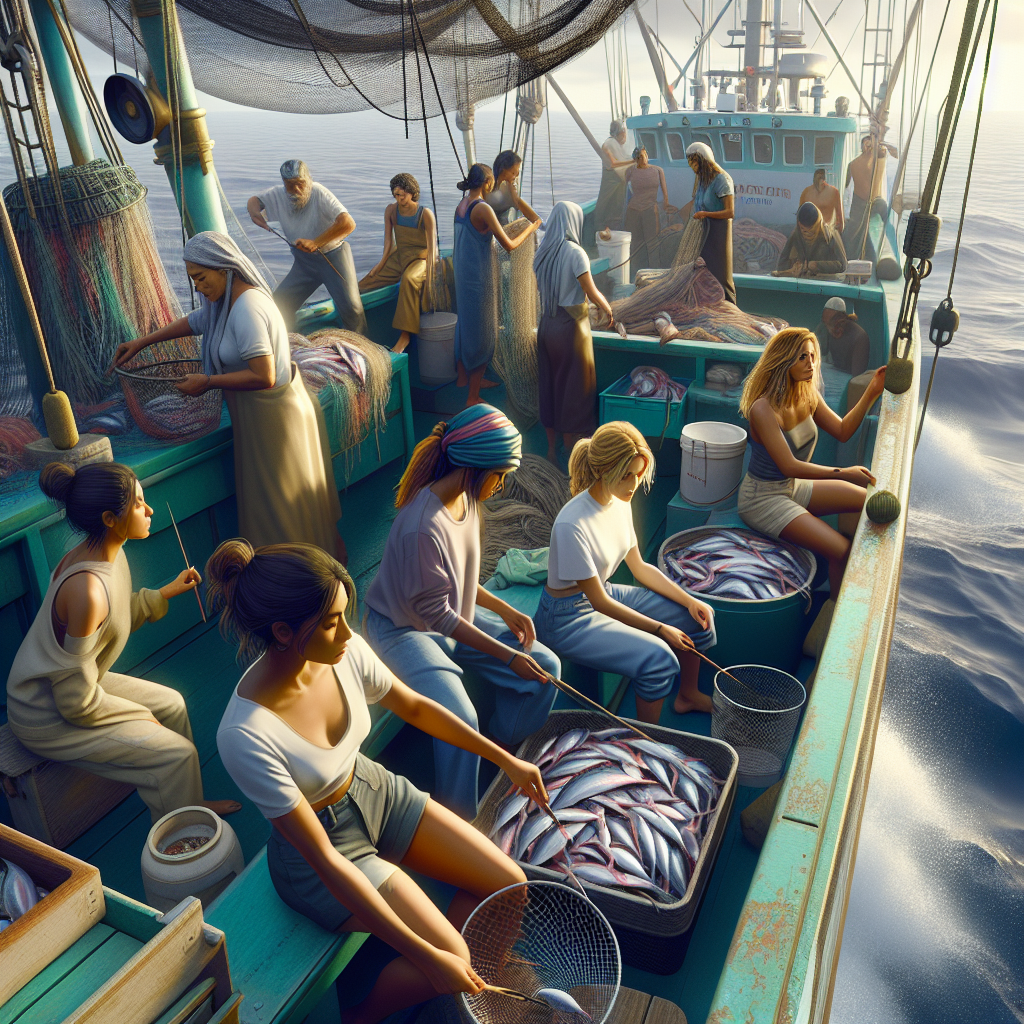
Women’s Contribution in Greenland’s Fishing Industry: An Underappreciated Shift
A recent report sheds light on the often-overlooked participation of women in Greenland’s fishing industry, revealing that they constitute less than two percent of the nation’s dinghy fishermen. While this figure is modest, it marks a notable improvement over the past few years.
Women are predominantly employed in roles such as production, office administration, and as cooks or mess assistants on trawlers. At sea, female crew members represent a mere 1–4 percent, although they can make up to 35 percent of the workforce in factories. Despite this representation, women remain largely absent from positions involving heavy machinery, reinforcing the notion that fishing is still a male-dominated field.
For many Greenlanders, the gender imbalance in the fishing sector is apparent, but the specifics are often less understood. The Department of Fisheries, Catching, Agriculture, and Self-Sufficiency has recently released a report aimed at mapping women’s roles in this critical industry and fostering a dialogue about gender equality.
The findings indicate that while women are engaged in various roles within the sector—ranging from fishermen and crew members to factory workers and inspectors—they still occupy a smaller share of these positions. Given that fishing resources are legally recognized as communal property, the predominance of men raises important questions about equal access to this profession.
A Gradual Shift
While the fishing industry remains largely male-dominated, there has been a gradual influx of women in recent years. By 2025, women will make up approximately 1.4 percent of dinghy fishermen and around 4 percent of trawler crews. This shift, albeit slow, is noteworthy: the number of female dinghy fishermen surged from just six in 2016 to 28 by 2025, with the most significant gains occurring after 2023. Particularly in Uummannaq, a substantial increase has been observed.
On trawlers, the female workforce has remained relatively stable, fluctuating between 63 and 73 in recent years. The majority of these women work as cooks, butlers, or fishery assistants, with only a few holding positions as fishermen or in management roles.
The report also highlights a lack of women in fisheries control, with numerous respondents pointing out a shortage of female colleagues. Conversely, women are better represented on land within the fishing industry, accounting for between 17 and 35 percent of employees, primarily in production and service roles.
Traditionally, fishing has been viewed as a masculine profession, often associated with challenging working conditions, which partly contributes to the gender disparity. Societal norms and access to this profession play crucial roles in shaping these dynamics.
With a more balanced gender representation, the report proposes that the industry could benefit from increased innovation and economic viability. By failing to fully engage women, society risks sidelining valuable insights and resources that could enhance the sector’s development.