
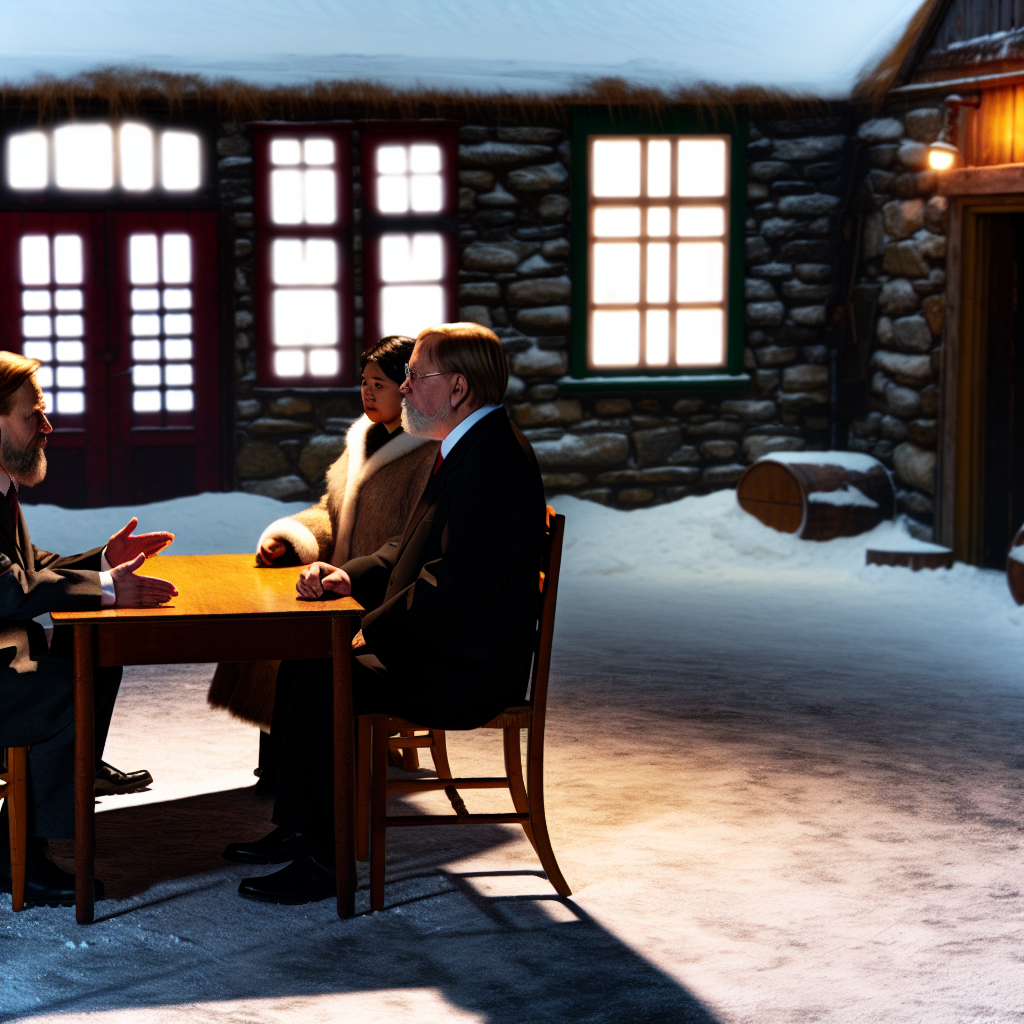
Resolving Tensions in the Arctic: A Call for Dialogue
Pele Broberg, chairman of the political party Naleraq, is stepping forward to clarify the narrative surrounding Greenland’s rearmament. Contrary to the Defense Ministry’s assertion that this military buildup is a response to Russian threats, Broberg believes the focus should instead be on Northeast Greenland—far from populated areas and closer to potential adversaries.
Broberg is not alone in seeking to shift the conversation. He shares the sentiments of Aleqa Hammond, the chairman of Siumut, who advocates for inviting Russia and other Arctic nations to Greenland to foster dialogue at a time when tensions are murky. Broberg insists that any such discussions should coincide with a reaffirmation of the Ilulissat Declaration.
“If you don’t talk to those you have a problem with, how can you solve those problems?” Broberg poses, emphasizing the need for open channels of communication among nations.
Understanding the Ilulissat Declaration
To grasp Broberg’s call to action, it’s crucial to understand the Ilulissat Declaration, established on May 28, 2008, among Canada, Denmark, Norway, Russia, and the United States. This agreement laid the groundwork for cooperation on climate change and environmental stewardship in the Arctic Ocean. Notably, it provides a legal framework for addressing disputes and outlines collaboration on security matters through bilateral and multilateral agreements. The spirit of the declaration emphasizes peaceful discourse and low-voltage diplomacy—principles that some argue are more relevant now than ever.
Since 2014, Russia has ramped up its military presence in the Arctic, further complicating the geopolitical landscape, especially following its suspension from the Arctic Council after the 2022 invasion of Ukraine.
Assessing Current Threats
This summer, Major General Søren Andersen, head of the Arctic Command, made clear in a KNR interview that Russia does not currently pose a direct threat to Greenland. The rearmament, he explains, is a precautionary measure to prepare for potential future shifts in security dynamics. “Both Russia and China are active in the Arctic near Alaska and the North Atlantic near Norway. It’s about readiness to protect the Faroe Islands, Greenland, and the entire kingdom,” he stated.
Yet, President Trump’s remarks on the new defense agreement between Denmark and Greenland, echoed by right-leaning media, suggest a narrative shift—one that Broberg finds concerning.
“The population seems to believe this rearmament is aimed at the U.S., not Russia,” Broberg notes. “It’s baffling that the community remains uninformed about these developments, especially when it’s framed as a defense against Russia.”
A New Approach
In calls for diplomatic engagement, Broberg aligns with Hammond, proposing another negotiation of the Ilulissat Declaration, perhaps to be hosted in Greenland. This move could welcome Russia into the fold of Arctic diplomacy, potentially fostering a climate of cooperation.
“Dialogue is key,” Broberg asserts. “If we’re calling for peace talks between Russia and Ukraine, shouldn’t we extend the same courtesy to our Arctic neighbors?”
He recognizes the challenges, particularly given Russia’s ongoing military activities, but stresses the necessity of communication as a means to avoid confrontation. “The prevailing belief that we must arm ourselves in response to others is a recipe for escalation,” he says. “We seek de-escalation, while the government appears to be leaning toward an opposite approach.”
Broberg’s reflections prompt us to consider: Is it realistic to expect peace through silence and distance, or should we actively seek to engage even those we view as rivals? His questions resonate deeply in the Arctic’s current geopolitical climate.