
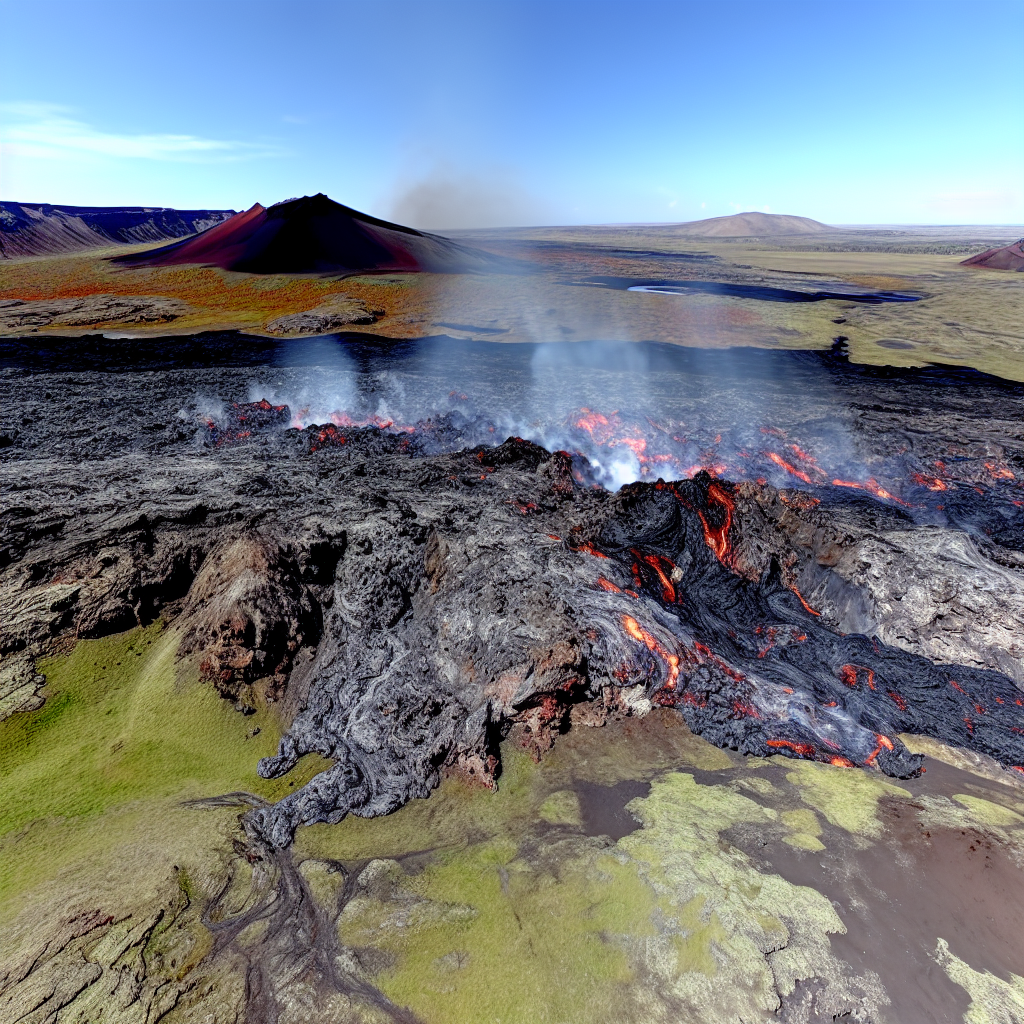
Volcanic eruption at Sundhnúkur, April 8, 2024.
Second Longest Eruption in the Reykjanes Peninsula Since 2021
Today marks a significant milestone: a month has passed since the eruption began at the Sundhnúkur crater row. This latest volcanic event, which commenced on the evening of March 16, represents the fourth phase in an ongoing series of eruptions that first ignited when magma began to build beneath Svartsengi last October.
The signs leading up to this eruption were brief but compelling. A small swarm of earthquakes was detected around 7:30 PM, intensifying just ten minutes later. Following this, GPS measurements indicated deformation in the area, signaling the start of a dike intrusion toward Sundhnúkur. By 8:23 PM, an eruptive fissure approximately three kilometers long had opened, stretching from Stóra-Skógfell to Sundhnúkur.
Initially, lava flowed southward and southeastward, following the protective barriers towards Suðurstrandarvegur, while also making its way northwest toward Grindavíkurvegur. Within four hours of the eruption, lava had cascaded over Grindavíkurvegur, just north of Svartsengi. Surveillance flights conducted by the Icelandic Coast Guard measured the lava flow speed at about one kilometer per hour.
The volcanic plume above Svartsengi, captured during the Coast Guard’s first surveillance flight on March 16. (Photo: Civil Protection/Björn Oddsson).
As concerns mounted about the potential for lava to reach the sea just east of Þórkötlustaðahverfi in Grindavík, authorities braced for localized hazards, including explosive reactions and gas emissions, particularly hydrochloric acid (HCl). Fortunately, the lava halted about 250 meters from Suðurstrandarvegur and has not advanced further.
This photo, taken on March 17, vividly illustrates ongoing monitoring as lava approached Suðurstrandarvegur road, raising concerns over potential coastal flow.
As night fell, the eruption settled into three distinct locations. While this early behavior mirrored previous eruptions at Sundhnúkur, it soon diverged. By the eleventh day, only three vents remained active, each extinguishing in turn until only one continued to flow on April 5. This remaining vent, situated just east of Sundhnúkur, remains the focal point of the eruption’s activity.
This image, taken from Sundhnúkur on April 10, shows the active crater. (Photo: Icelandic Meteorological Office/Jón Bjarni Friðriksson).
Second Longest Eruption in the Reykjanes Peninsula Since 2021
In comparison to recent eruptions at the Sundhnúkur crater row, the current event stands out for its duration. It is the second-longest eruption on the Reykjanes Peninsula since 2021, bested only by the initial eruption at Fagradalsfjall, which raged for around six months beginning in March 2021. By contrast, the Merardalir eruption of August 2022 lasted just 18 days, and the July 2023 eruption at Litli Hrútur lasted for 26 days. Previous eruptions at Sundhnúkur—occurring in December 2023, January 2024, and February 2024—were significantly shorter.
The accompanying animated image illustrates the four lava fields formed since December 2023, including those from eruptions on December 18-21, January 14-16, February 8-9, and the ongoing eruption since March 16. As of April 8, the current lava field spans approximately 6.14 square kilometers.
As the eruption continued, evidence suggested that the rate of land uplift had slowed considerably and nearly ceased. This indicated a delicate balance was struck between magma inflow into the underground reservoir and the lava being extruded on the surface.
Since early April, ground uplift has shown signs of regaining momentum with increased pressure in the magma reservoir below Svartsengi. Although some magma continues to flow out during the eruption, the situation remains precarious, underscoring the need for vigilance.
A New Trend in Monitoring Land Uplift During Eruptions
The unfolding events at Sundhnúkur evoke comparisons to the Krafla volcanic system, which experienced 20 dike intrusions and nine eruptions over a decade, albeit with varying intensities. However, the eruptions at Krafla occurred at irregular intervals, unlike the one-month consistency seen in the Sundhnúkur eruptions since December 18, 2023.
This steady rhythm of volcanic activity is unprecedented. However, the pattern was temporarily disrupted by a dike intrusion on March 2 that did not lead to an eruption, and we are now witnessing the unusually long duration of the current event. Only time will reveal when magma accumulation beneath Svartsengi will cease, bringing an end to this cycle of eruptions.
Despite the extended duration of the current eruption, it does not signal the end of the ongoing magma buildup beneath Svartsengi. Historical patterns suggest that magma inflow remains steady, much like the volcanic unrest experienced in Reykjanes between 2020 and 2022, during which four magma accumulation periods occurred, followed by lengthy pauses.
The current situation—characterized by continued uplift in Svartsengi during an ongoing eruption—is notably rare. Continuous monitoring is imperative to ensure the safety of the surrounding communities and to minimize potential damage in the region.