
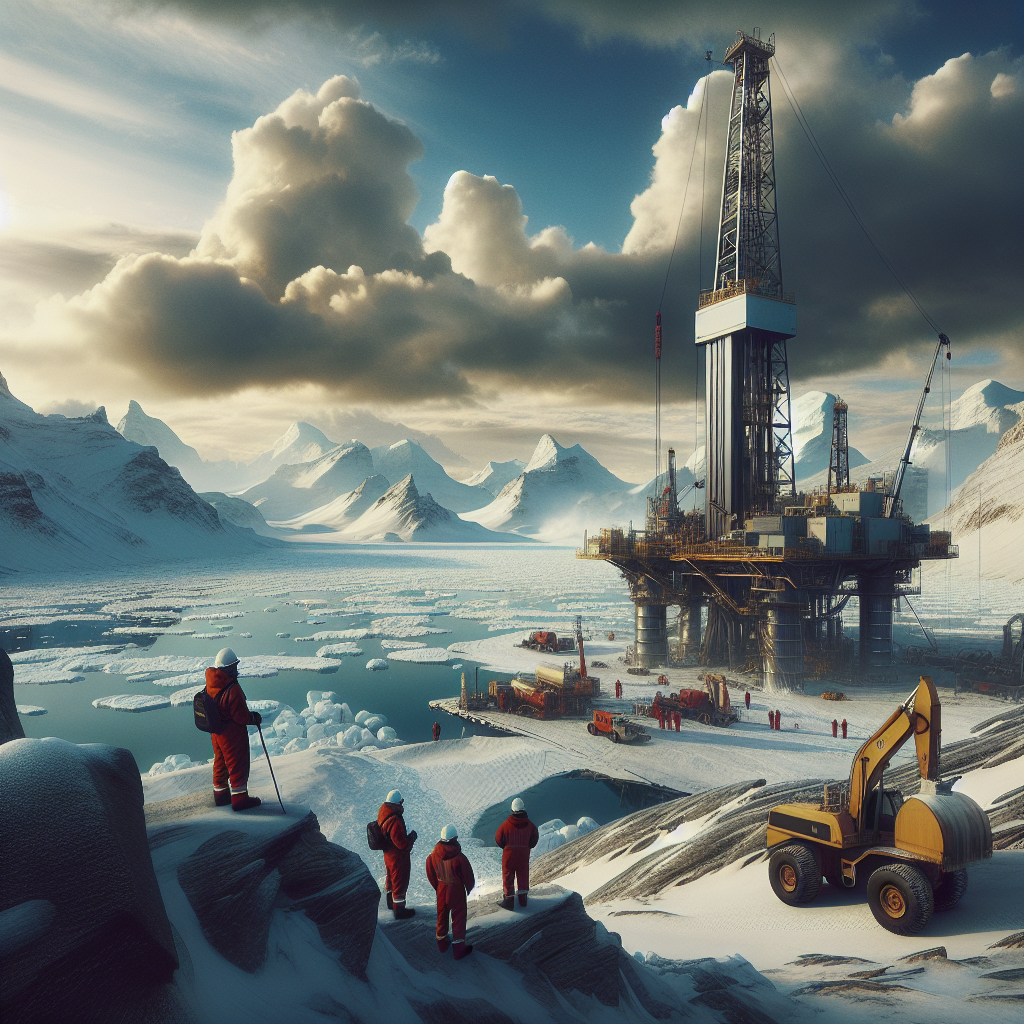
A New Oil Venture in Jameson Land: Is it a Dream or a Reality?
In the remote expanse of Jameson Land, an ambitious oil venture is on the horizon, or so asserts Robert B. Price, director of the American firm Greenland Energy Company. This year, Price has set his sights on uncovering what he believes could be a staggering 13 billion barrels of oil in the region.
In October, he made a trek to Tasiilaq, accompanied by an array of drilling technology and a dedicated crew, with plans to ship the equipment to Jameson Land this summer. Notably, the machinery comes from Halliburton, a company often mired in controversy due to its connections to environmental catastrophes and its role in the Iraq war.
Yet, experts caution against such optimism. Sources consulted by KNR suggest that the prospect of finding such vast reserves may be, at best, overly ambitious.
Questionable Estimates
According to a 2022 analysis from Geus, Nunaoil, and the Greenlandic government, the actual estimated reserves hover around a mere 350 million barrels. Thomas Varming, a geologist and head of Geus’ Nuuk office, was instrumental in preparing this report for Nunaoil. He emphasizes that the data regarding potential reserves are riddled with considerable statistical uncertainty.
“The figures being touted by Greenland Energy Company are numbers we generally avoid using,” Varming remarked. He suggested that the company’s claim of 13 billion barrels is fraught with even greater uncertainty. “Based on assessments, the likelihood of such an find is only about 10%. This is often seen as over-optimistic; typically, we aim for a 90% probability assessment.”
Support from Authorities
KNR reached out to Jørgen Hammeken-Holm, the head of the Raw Materials and Business department. He confirmed that Greenland Energy Company acquired exploration and extraction licenses from the firm White Flame for Jameson Land. Echoing Varming’s concerns, Hammeken-Holm believes the chances that the Americans’ hopes of an oil bonanza will materialize are slim.
“I would say there’s a significant risk that nothing will be found at all,” he remarked.
Should they make a significant discovery, Hammeken-Holm anticipates a lengthy process before oil could hit the market. “In the best-case scenario, it could take five to ten years. They will need to secure essential paperwork, including environmental approvals and shutdown plans,” he explained.
At present, the company is considering drilling two exploratory wells to gauge the existence of oil deposits.
Navigating Regulations
In July 2021, the previous government, led by the parties Inuit Ataqatigiit and Naleraq, instituted an oil ban. This ruling aimed to halt oil exploration and pivot the focus towards renewable energy sources. Thus, KNR inquired how Greenland Energy Company remains active in oil exploration despite the ban.
Hammeken-Holm clarified that the company’s licenses were issued before the law took effect, exempting them from the current restrictions. “As it stands, I can’t see how the ban impacts them,” he noted. “They are permitted to investigate the area. If they comply with all our conditions, they can also extract what they find.”
He urged for clarity regarding the distinctions between the regulations governing oil and uranium exploration, arguing that the oil ban was a political decision enacting a halt on future oil ventures while allowing previously granted licenses to remain valid.
“It’s understandable that Energy Transition Minerals (ETM) might question why the department scrutinizes them for new licenses, yet allows oil companies to proceed,” he remarked, acknowledging the ongoing legal scrutiny of this very issue.
As the situation unfolds, the potential oil adventure in Jameson Land remains an intriguing yet uncertain prospect, filled with both hope and skepticism.