
On a modest office table nestled next to a warehouse, a soft, gray-black stone catches the eye, dusting fingers with a fine residue. This unassuming mineral is graphite — widely recognized as the core of a pencil but now experiencing soaring demand as a critical component in lithium batteries.
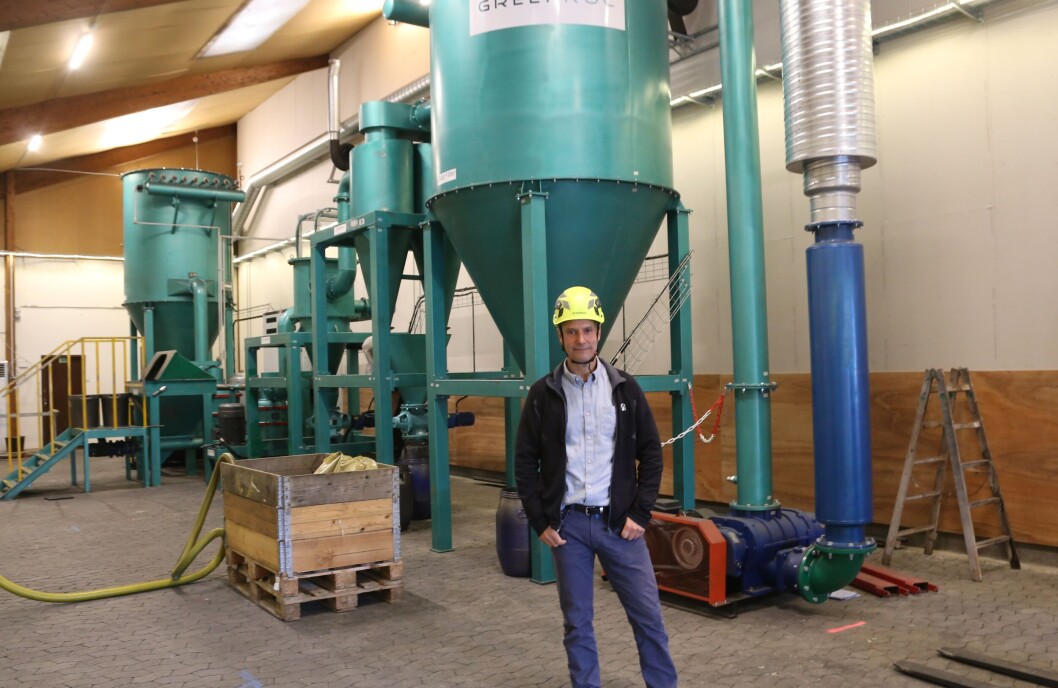
GreenRoc Strategic Materials, through its subsidiary Greenland Graphite, holds a 30-year exploitation permit for graphite sourced from Piiaaffik Amitsoq near Nanortalik. The company is currently testing its graphite concentrate in a newly constructed pilot plant located in Hørsholm, just north of Copenhagen.
### The First Pilot Process Plant in Europe
This facility serves as a micronization and spheronization plant, which converts graphite flakes into perfectly shaped microscopic spheres over 20 to 30 processing rounds. This innovative technology, originally developed in China, is being explored on a smaller scale by GreenRoc.
So far, the pilot plant has processed several batches of 100 kilos of graphite concentrate, yielding promising initial results, according to Director Stefan Bernstein, a geologist with a Ph.D. and former head of the mineral department at GEUS.
“Our plant is the first of its kind in Europe to transform natural graphite flakes into spheronized spheres. Early data indicates we’re on the right track towards optimizing particle size and shape,” he explains. The spherical shape is essential for enhancing battery efficiency, allowing lithium ions to move swiftly during charging and discharging cycles. Additionally, the reduced surface area relative to volume extends battery lifespan.
### Chemical Baths and Advanced Processing
However, achieving these desirable properties necessitates thorough cleaning of the graphite balls. Later this year, GreenRoc plans to incorporate chemical baths into the pilot plant. In China, this is typically accomplished using highly corrosive hydrofluoric acid. GreenRoc’s approach is more environmentally friendly, utilizing sodium hydroxide, or caustic soda, which is easier to manage.
“Sodium hydroxide is heated to clean the graphite, which is then treated with sulfuric acid,” Bernstein elaborates. What follows is a meticulous process where each graphite sphere is coated and heated before reaching customers, primarily battery manufacturers. A letter of intent has even been signed for continued processing at a facility in Asia.
### A Mineral in Demand
The establishment of the pilot plant has been bolstered by a loan of 5.2 million euros (approximately 39 million kroner) from Denmark’s Export and Investment Fund (EIFO), which is also earmarked for an upcoming drilling program at Amitsoq.
“We’ll kick off the drilling by the end of June, running for about six to seven weeks,” says Bernstein. Insights gained from both the drilling campaign and the pilot plant will inform a larger profitability study. A full-scale processing facility is anticipated, likely situated in either Norway or Denmark.
Bernstein notes, “In a few years, we aim to establish the mine and crushing plant at Amitsoq alongside the processing plants in Denmark or Norway.”
### Considerations on Location
When asked why the process plant isn’t situated in Greenland, Bernstein explains, “A processing plant demands substantial energy. Additionally, environmental challenges arise in managing cleaning chemicals, which are more effectively handled in areas with established chemical industries, like Denmark or Norway.”
Today, China dominates graphite production, accounting for about 80% of global output and 99% of the processing of natural graphite into spherical forms. As GreenRoc forges ahead, it aims to carve out a significant presence in this vital industry.