
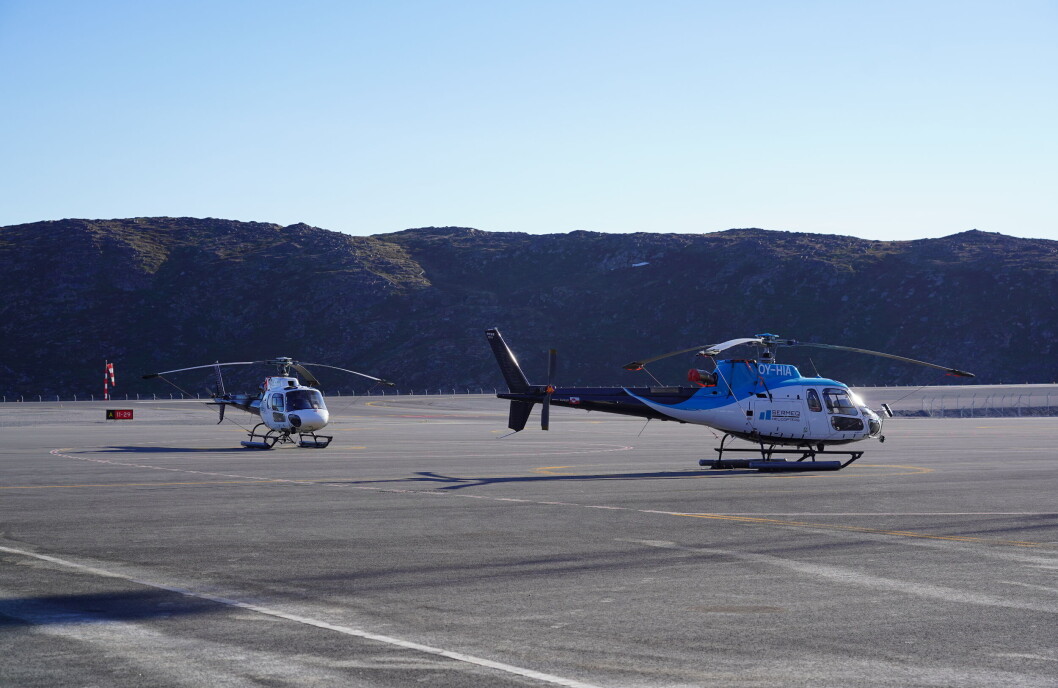
Challenges and Triumphs: Sermeq Helicopters’ Journey in Qaqortoq
The road has been far from smooth for Sermeq Helicopters, the helicopter charter company based in Qaqortoq, which stands as the primary provider of helicopter tours in South Greenland, offering tourists easy access to this breathtaking region. Not long ago, Sermeq Helicopters found themselves reaching out to customers via Facebook, extending an apology for the hurdles they faced.
In their message, they conveyed important updates:
“We regret to inform you that the construction of our hangar at Qaqortoq Airport has encountered delays, and as a result, we have yet to relocate. Currently, we are still parking our helicopters at the old heliport, though passenger operations are not permitted there. Compounding this, our office facilities at the airport are not yet available, requiring our team to commute morning and evening to manage operations.”
They concluded with an assurance of improved clarity in the coming week and expressed their gratitude for the understanding of their loyal customers.
The series of delays created challenges: employees worked without a fixed office space, and the necessity of daily commutes added logistical strain to an already complex operation. Yet, fast-forward to today, and the sentiment surrounding Sermeq Helicopters has transformed markedly, particularly as shared by the company’s CEO, Pilu Nielsen.
“We now have office facilities right at the airport—everything is consolidated in one location,” Nielsen proudly explained. “Previously, our offices were scattered, with the main office in Qaqortoq Heliport and mechanics stationed in Narsarsuaq. Now, everyone works here at Qaqortoq Airport.”
This transition is more than just a physical move; it represents a significant shift in how the company operates. Although traveling to the hangars takes more time, the logistical advantages of having the team under one roof far outweigh the inconvenience.
Fog and Staffing Challenges
To grasp why the new airport represents a breakthrough for aviation in Qaqortoq, one only needs to glance at social media. A recent photo on Sermeq Helicopters’ Facebook page illustrated Qaqortoq enveloped in a dense layer of harbor fog, in stark contrast to the clear skies over the new airport—a visual testament to the operational advantages.
“The best part is saying goodbye to the fog,” Nielsen stated. “As we highlighted on June 9, although Qaqortoq can be shrouded in thick fog, the airport has impressively clear visibility. Mornings are often fog-free, allowing us to operate from early dawn until late evening.”
While Sermeq Helicopters now shares airspace with larger, fixed-wing aircraft, the seasoned pilots have adapted seamlessly. Coordination with the newly established air traffic control tower mirrors the systems from Narsarsuaq, ensuring safety remains paramount. However, moving into a state-of-the-art facility has presented its own set of hurdles.
“The most time-consuming aspect has been familiarizing ourselves with the new airport protocols,” Nielsen explained. “Additionally, staffing shortages have hampered our ability to obtain approvals for extended operating hours, a challenge affecting much of the country, not just us.”
The shortage of manpower has impacted their requests to keep the airport operational beyond standard hours, a concerning trend that mirrors labor challenges across Greenland.
A New Era of Connectivity
The company also benefits from enhanced synergy with international flight schedules. Icelandair’s increased frequency of flights to Qaqortoq has improved logistical connections, contrasting sharply with the previous two flights a week to Narsarsuaq.
Financially, the move has been stable; airport tariffs remain uniform across the nation. When asked if the relocation has enhanced or detracted from Sermeq Helicopters’ logistical capabilities, Nielsen answered unequivocally: “It’s definitely an upgrade.”
This transition signifies more than just the fusion of services; it heralds a new chapter for Sermeq Helicopters and the communities they serve, paving the way for growth and greater access to the majestic landscapes of South Greenland.